
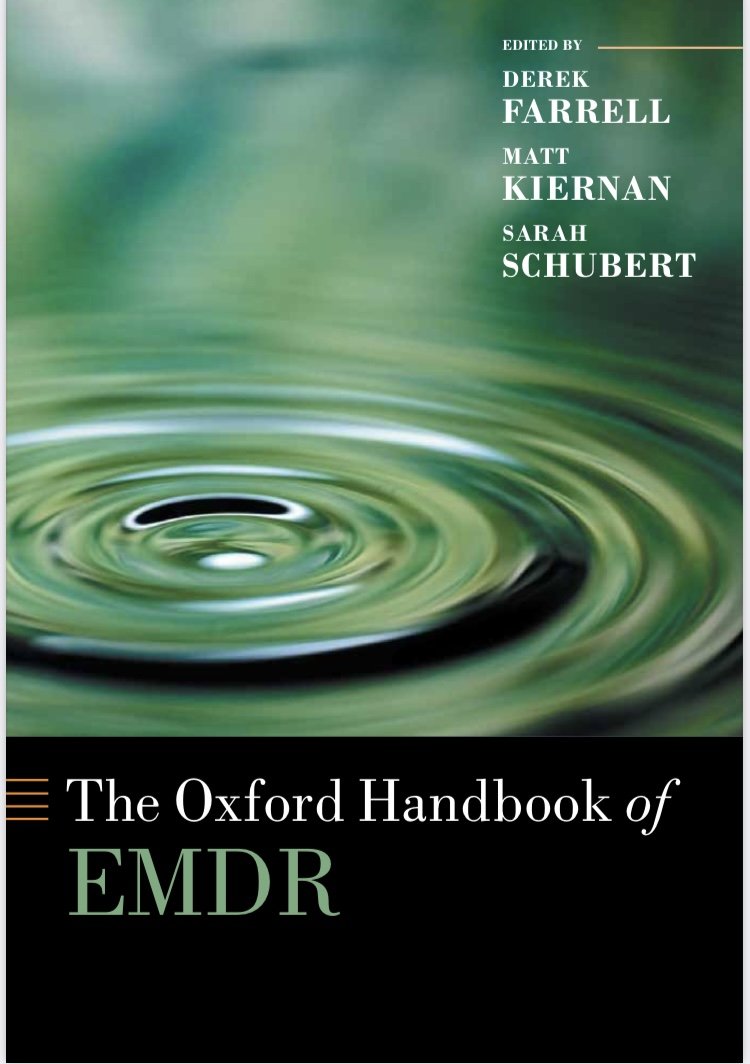
Profondamente grata per avere avuto l’onore di contribuire alla prima edizione di The Oxford Handbook of EMDR, pubblicato da Oxford Academic a cura di Derek Farrell (ed.), Sarah J. Shubert (ed.), e Matthew D. Kiernan (ed.). Il manuale, attualmente in corso di pubblicazione, fotografa con precisione lo stato dell’arte della psicoterapia EMDR (Eye Movement Desensitization and Reprocessing) nei suoi diversi ambiti di applicazione. Con autori della caratura di Andrew M. Leeds, Sarah K. Domiguez, Roger Solomon, Kathy Steele e molti altri, The Oxford Handbook of EMDR presenta il progresso della ricerca sulla psicoterapia EMDR con dettagliati approfondimenti su specifiche popolazioni cliniche. L’autorevole trattazione, costellata di potenti insights, consente l’accesso ad una comprensione particolarmente approfondita dell’EMDR e del modello teorico ad esso sotteso (AIP, Adaptive Information Processing).
Il contributo di Elisa Faretta e mio è relativo all’impiego dell’EMDR nel trattamento del Disturbo di Panico e Agorafobia, un tema sul quale da qualche tempo ci confrontiamo a partire dalle rispettive pratiche cliniche e, per quanto riguarda Elisa, dalla ricerca sul campo (Faretta, E., 2018; Faretta, E., & Dal Farra, M., 2019). L’impiego della psicoterapia EMDR nel DP è basata sull’assunto che il panico e l’agorafobia possano avere un’eziologia di tipo traumatico (con la dissociazione come potenziale fattore causale e di mantenimento), e che gli attacchi di panico possano inoltre configurarsi di per sé come esperienze traumatiche. Il capitolo contiene una revisione della ricerca in quest’area e descrive le linee-guida EMDR per la concettualizzazione e la pianificazione dell’intervento terapeutico per il DP, con o senza Agorafobia.
Il mio personale e più sentito auspicio è che The Oxford Handbook of EMDR possa contribuire a rendere la pratica clinica sempre più compiutamente informata dalla comprensione scientifica del lavoro svolto in studio, con particolare riferimento all’EMDR: un paradigma terapeutico efficace, generativo e in costante evoluzione.
Deeply grateful for the honor of contributing to the first edition of The Oxford Handbook of EMDR, published by Oxford Academic, edited by Derek Farrell (ed.), Sarah J. Shubert (ed.), and Matthew D. Kiernan (ed.). The handbook, currently in publication, accurately captures the state of the art of EMDR (Eye Movement Desensitization and Reprocessing) psychotherapy in its various fields of application. With authors such as Andrew M. Leeds, Sarah K. Domiguez, Roger Solomon, Kathy Steele, and many others, The Oxford Handbook of EMDR presents the progress of EMDR psychotherapy research with detailed insights into specific clinical populations. The authoritative dissertation, studded with powerful insights, allows access to a particularly in-depth understanding of EMDR and the theoretical model underlying it (AIP, Adaptive Information Processing).
The contribution of Elisa Faretta and myself is related to the use of EMDR in the treatment of panic disorder and agoraphobia, a topic on which we have been discussing for some time starting from our respective clinical practices and, as far as Elisa is concerned, from field research (Faretta, E., 2018; Faretta, E., & Dal Farra, M., 2019). EMDR therapy for panic disorder and agoraphobia is based on the premise that panic and agoraphobia may have a traumatic etiology (with dissociation as a possible causal and maintaining factor), and that panic attacks can be considered as a traumatic experience in their own right. The chapter reviews the research in this area, and also illustrates the EMDR guidelines for the conceptualization and planning of the therapeutic intervention for panic disorder, with or without agoraphobia.
My personal and most heartfelt hope is that
The Oxford Handbook of EMDR
can contribute to making clinical practice increasingly fully informed by the scientific understanding of the work carried out in the studio, with particular reference to EMDR: an effective, generative and constantly evolving therapeutical paradigm.
#oxfordhandbookofemdr #oxfordlibraryofpsychology #EMDR #EMDRIA #EMDRitaly #AIP #panicdisorder #elisafaretta #sarahshubert #derekfarrell #matthewkiernan
 mariella dal farra